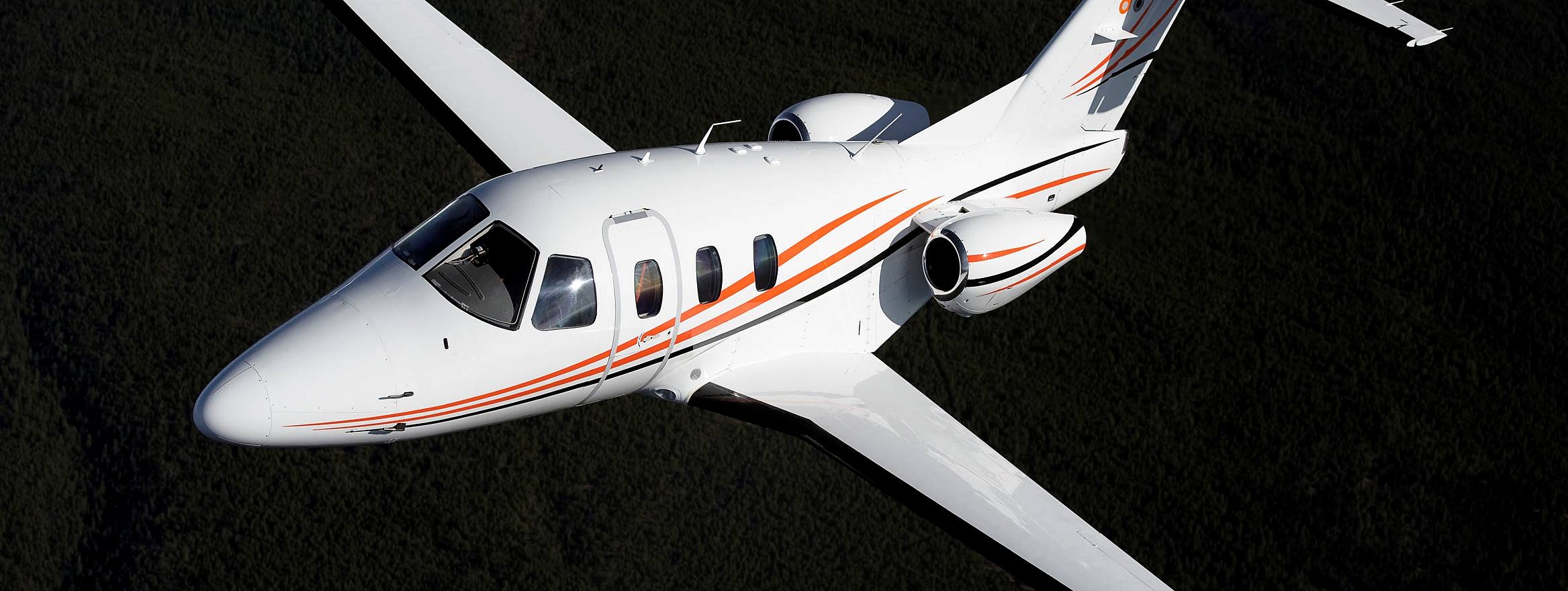
Charter Eclipse 500
685 km/h
2084 km
5 seats
Specifications
| Manufacturer: | Eclipse Aviation |
| Class: | Superlight plane. |
Flight performance
| Range: | 2084 km |
| Cruising speed: | 685 km/h |
Cabin specifications
| Maximum passengers: | 5 |
| Typical passengers: | 5 |
| Cabin length: | 3.76 m |
| Cabin width: | 1.42 m |
| Cabin height: | 1.27 m |
| Baggage capacity: | 0.45 m³ |
Aircraft description
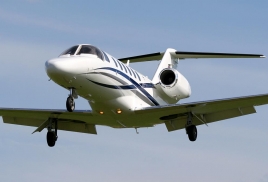
The Eclipse 500 is a lightweight six-seater business jet. Initially, it was an experimental Williams V-Jet II, designed and built in 1997 by Scaled Composites for Williams International to test the new FJX-2 turbojet.
The aircraft fitted with the new engine first flew in 1997 at the Experimental Aircraft Association air show in Oshkosh. It had a forward-swept wing, a V-tail and an all-composite structure. Interest in the concept led to the formation of Eclipse Aviation in 1998 to develop the programme.
The design was subsequently revised to use an all-metal fuselage, a straight wing and a conventional T-tail. Advanced manufacturing techniques were introduced to maximise automation. The Eclipse 500 was developed for two Williams International EJ-22 engines, a production version of the FJ22/FJX-2 turbofan. Its performance with these engines, first flown on August 26, 2002, was unsatisfactory, leading to the installation of two PW610F engines. The prototype with Pratt & Whitney engines first flew on December 31, 2004.
The main distinguishing feature of this model is the minimum operating costs for flights.
Other aircraft in this category
Embraer
Embraer Phenom 300
Speed
Range
Seats
834 km/h
3334 km
8
Cessna Aircraft Company
Cessna Citation Bravo
Speed
Range
Seats
750 km/h
2850 km
8
Cessna Aircraft Company
Cessna Citation CJ1 / CJ1+
Speed
Range
Seats
720 km/h
2400 km
7
Cessna Aircraft Company
Cessna Citation CJ2 / CJ2+
Speed
Range
Seats
774 km/h
3000 km
9